How to Become a Notary Public (2026)
State-by-state requirements, application fees, bond amounts, and exam rules — all sourced from official state government pages.
How to Become a Notary — Step by Step
Becoming a notary public involves a state government application process. The steps are similar across states, but requirements vary significantly — some states take 2 weeks and cost $30, others require an exam, a large bond, and cost $400+. Here's the universal process:
Check your state's requirements
Every state sets its own rules — fees, bond amounts, exam requirements, and commission terms. Use the state guide below or click your state to see the exact requirements from the official government source.
Complete required education (if your state requires it)
About 15 states require a state-approved education course before you apply. Course lengths vary: 3 hours (Florida, Ohio, Pennsylvania), 4 hours (Montana), 6 hours (California, North Carolina, New Jersey). Florida and Texas require courses only for first-time applicants. Courses are available online through state-approved providers and typically cost $20–$80.
Pass the notary exam (if required)
Around 11 states require a written exam: Arizona, California, Georgia, Louisiana, Maryland, Missouri, Montana, Nevada, New Jersey, New York, and Ohio. Exam fees range from $10 (Hawaii) to $100 (Louisiana). California's exam requires a 70% pass score; Georgia requires 90%. New York attorneys and certain court clerks are exempt.
Obtain a surety bond (if required)
30 states require a surety bond before commissioning. Bond amounts range from $500 (Wisconsin) to $50,000 (Alabama, Louisiana). You purchase the bond from a licensed insurance or surety company — the actual cost is typically $35–$100 for your full commission term, regardless of the bond face value. The bond protects the public from notary errors; it does not protect you personally.
Submit your application and pay the fee
File your application with your state's commissioning authority — usually the Secretary of State, though some states use a county office (Georgia files with the Clerk of Superior Court; Tennessee files with the County Clerk; Virginia files with the Secretary of the Commonwealth). Application fees range from $10 (Colorado, Kentucky) to $200+ (Louisiana).
Take your oath of office
Most states require you to take an official oath of office within a set window after receiving your commission (typically 30–90 days). In California, you also file your bond with the County Clerk at this step. In Virginia, you take the oath at your local Circuit Court. Missing the oath deadline can void your commission.
Purchase your notary supplies
Order your official notary seal/stamp and a notary journal. Most states require a specific seal format — check your state's rules on shape, ink color, and required text.
A state-by-state reference covering notary fee caps, remote online notarization (RON) availability, and step-by-step instructions for getting documents notarized from home. Know your rights and the legal maximums before you pay a notary.
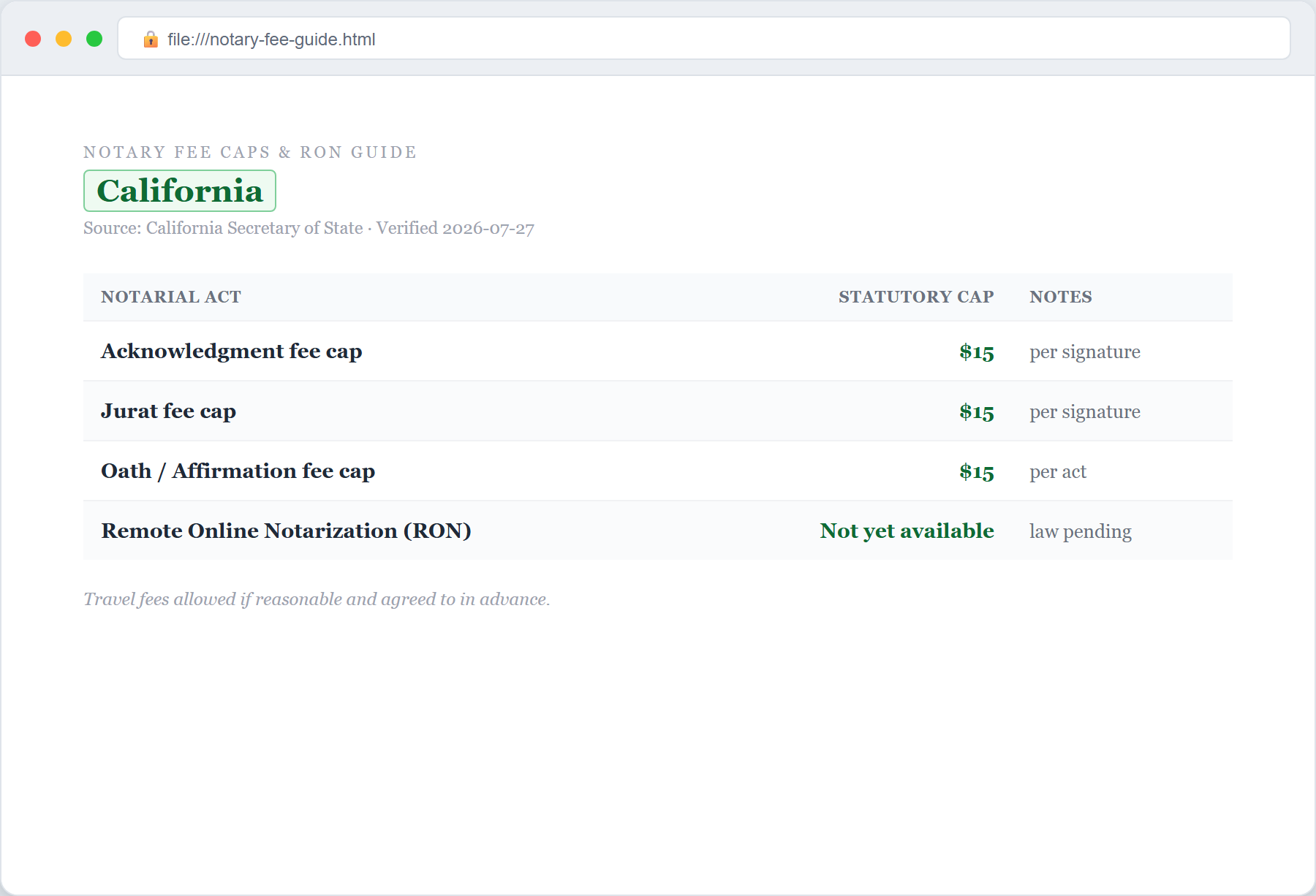 See exactly what you get
- All 50 states — fee caps for acknowledgments, jurats, oaths, and RON
- RON status for every state — which states allow remote online notarization in 2026
- Step-by-step guide to getting documents notarized via video call
- Mobile notary tips — what to ask upfront, how to avoid overcharging
- Instant download — open in any browser, print to PDF
HTML
Secure checkout via Payhip · Instant delivery · 30-day guarantee
Get Your Notary Training Materials
NotaryPublicCentral offers state-specific training courses, study guides, and exam prep. Use code LEGALCOSTCALC for $10 off.
Requirements by State — All 50 States
Click any state for the full guide including step-by-step instructions, all fees, and a direct link to the official state government source.
No states match your search.
Total Cost to Become a Notary — What to Budget
The state application fee is just one part of your startup cost. Here's a full breakdown of every potential expense:
| Cost Item | Range in our table | Required? |
|---|---|---|
| State application fee | $10 – $120 | Yes, in every state |
| Surety bond | Bond amount from $500 to $50,000; the bond's price depends on the surety | 30 jurisdictions |
| Education course | Set by the state or its approved providers | 19 jurisdictions |
| Exam | Set by the state | 20 jurisdictions |
| Stamp, seal and journal | $35 – $60 (our estimate) | Yes, in most states |
Counts and fees come from our state table, and each state page links to that state's own notary page. Course and exam prices vary by state and provider, so we do not quote a typical range.
Cheapest States to Become a Notary
The lowest filing fee in our table is $10, in Colorado (bond optional, with free state training and an online exam) and Kentucky ($1,000 surety bond posted through the county clerk). Both figures are confirmed on the state's own pages. Illinois and Ohio list $15 in our table, but each also requires a course or exam.
Most Expensive States to Become a Notary
Hawaii adds up to $130 for a first attempt: a $20 application, a $100 commission fee and a $10 exam fee, all listed in the Attorney General's fee schedule. Connecticut and Minnesota also list $120 filing fees in our table. In Louisiana the fee table totals $70 for the application and commission documents, plus a $100 exam registration fee and a $50,000 bond.
Turn Your Notary License Into a $75–$200/Signing Business
Notary signing agents complete real estate loan closings — one of the most lucrative uses of a notary commission. Loan Signing System teaches you how to get signings and build a full-time income from your notary license.
Remote Online Notarization (RON)
Remote Online Notarization (RON) lets you perform notarizations via live audio-video call. It's a separate authorization from your standard notary commission — available in 36 states as of 2026. To become a RON notary, you typically need to:
- Hold a valid traditional notary commission in your state
- Register as an electronic/online notary with your state (extra fee in most states)
- Use a state-approved RON platform (Proof, DocuSign Notary, NotarizeME, etc.)
- Complete any additional state training requirements for RON
States that do not currently permit RON include Georgia, South Carolina, and a handful of others. California has RON legislation pending. Check your state's page below for current status.
How Much a Notary License Costs: $10 in Colorado, $130 in Hawaii
The state filing fee is the number people search for, and it varies more than most guesses. In our table of all 50 states and DC, the middle fee is $40, 14 states sit at $25 or less, and three (Connecticut, Minnesota and Hawaii) charge $120. The two lowest, Colorado and Kentucky, both charge $10.
We re-checked three of these against the state's own pages in November 2026. Colorado's fee schedule lists the notary application at $10.00 online, the same for renewal. Kentucky's application form says the fee is $10, payable by check to the Kentucky State Treasurer or electronically when you apply online. Hawaii splits its cost into three charges in the Attorney General's fee schedule: a $20 application, a $100 commission issuance fee and a $10 fee for each examination, which adds up to $130 for a first attempt (our table lists the $120 filing fees and the $10 exam fee separately). The Hawaii schedule on file is the one effective January 1, 2020, so confirm the current figures when you apply.
Sources: Colorado notary fee schedule, Kentucky notary application, Hawaii notary fee schedule (checked November 2026)
The Filing Fee Is Not the Whole Price: Kentucky's Bond, Colorado's Free Course
Two $10 states show why the headline fee misleads. In Kentucky, approval comes by email, and the notification then tells you to contact the county clerk to post the required $1,000 surety bond, take the oath of office and receive your commission certificate. The $10 goes to the Secretary of State; the bond and clerk steps come on top. Kentucky also limits where you can commission: you must live or work in the county of commission, and the state does not commission people who neither live nor work in Kentucky.
Colorado works the other way. Its FAQ says new notaries and renewing notaries must attend approved training and take an online examination, and the Secretary of State's office provides the course and exam free through its eLearning system. It says a bond is optional, and commissions run four years. So the cost to start in Colorado is the $10 filing fee plus your stamp and journal.
When you budget, add up what your state asks for in order: filing fee, any bond, any course or exam, then supplies. Our state pages list each of these for your state. Requirements for courses and exams change, so confirm them on your state's own notary page before you pay for anything.
Sources: Kentucky notary application and instructions, Colorado notary FAQ (checked November 2026)
Comparing All 50 States: What the Table Above Does and Does Not Show
The state table lists each state's application fee, commission term, bond and exam status. Use it to narrow the field, then open your state's page for the steps and a link to the office that issues commissions. Most states commission for four years (30 of the 51 jurisdictions in our table), so a $50 fee spread over four years costs less per year than a $30 fee on a two-year term like Vermont's.
Treat the exam and course columns as a starting point rather than a final answer. Colorado shows how a state can add training and an online exam while keeping a low fee, and a single table cell cannot carry that detail. If the exam column says No and you want to be sure, read the state's FAQ before you skip studying.
Source: Colorado notary FAQ (checked November 2026)