How to Become a Notary in Connecticut (2026)
Step-by-step guide to getting your Connecticut notary commission — fees, bond, exam, and timeline. All data from official Connecticut state sources.
A state-by-state reference covering notary fee caps, remote online notarization (RON) availability, and step-by-step instructions for getting documents notarized from home. Know your rights and the legal maximums before you pay a notary.
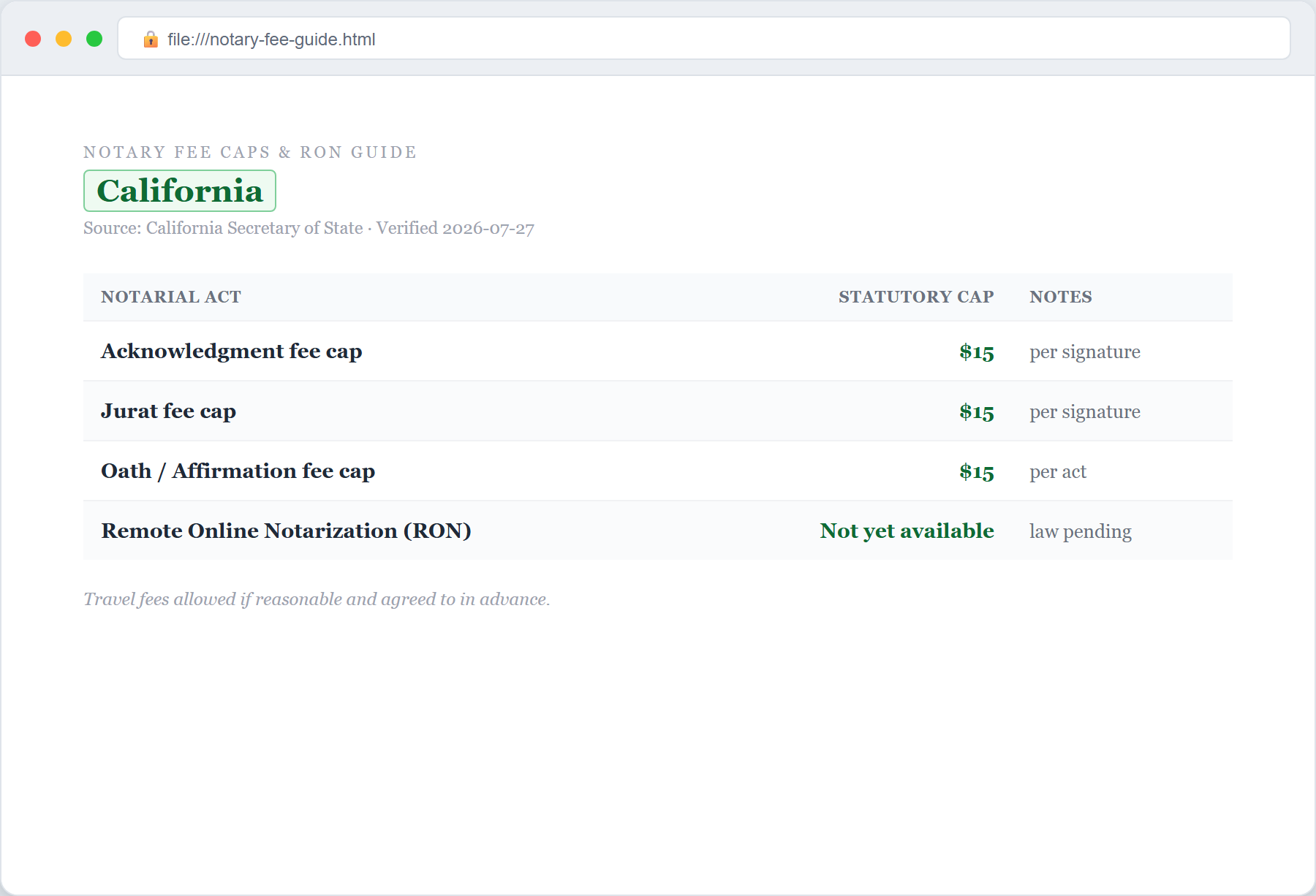 See exactly what you get
- All 50 states — fee caps for acknowledgments, jurats, oaths, and RON
- RON status for every state — which states allow remote online notarization in 2026
- Step-by-step guide to getting documents notarized via video call
- Mobile notary tips — what to ask upfront, how to avoid overcharging
- Instant download — open in any browser, print to PDF
HTML
Secure checkout via Payhip · Instant delivery · 30-day guarantee
How to Become a Notary in Connecticut — Step by Step
Meet the eligibility requirements
To become a notary in Connecticut, you must be at least 18 years old, a legal U.S. resident, and either a resident of Connecticut or regularly employed there. You cannot have felony convictions (in most states) unless your civil rights have been restored.
Pass the notary exam
Connecticut requires all applicants to pass a written notary exam. Schedule your exam through the state or an approved testing provider. Study the Connecticut notary handbook — available free from the Secretary of State.
Submit your application to the Secretary of State
File your completed notary application with the Secretary of State and pay the $120 application fee. Include your exam pass certificate. Most states now accept online applications.
Receive your commission and take your oath of office
After your application is approved, you'll receive your notary commission certificate. You must then take an official oath of office — typically before a notary public, judge, or court clerk — by the deadline in your commission letter.
Purchase your notary supplies
Order your official Connecticut notary seal or stamp and a notary journal/record book. Most states require a specific seal format — check the Secretary of State requirements for approved shapes, ink colors, and required text.
Start notarizing — and consider signing agent training
Once commissioned, you can begin performing notarizations in Connecticut. Traditional notary fees in Connecticut: up to $10 per act (state-capped). Connecticut also allows Remote Online Notarization (RON), capped at $10 per act — a growing income opportunity. For higher earnings, consider training as a notary signing agent (see below).
Get Your Connecticut Notary Training Materials
NotaryPublicCentral has state-specific study guides and training for Connecticut. Use code LEGALCOSTCALC for $10 off.
Connecticut Notary Commission — Cost Summary
| State application fee | $120 |
| Commission term | 5 years |
| Surety bond | Not required |
| Exam | Required |
| Education course | Not required |
| Filing office | Secretary of State |
| RON available | Yes |
| Fees charged by the state (application + exam) | $120 |
$120 for a new commission ($60 to renew), paid online through eLicense. The application contains an examination on the Notary Public Manual; every question must be answered correctly before the commission is issued. Terms are five years. Active state employees can have the fee waived.
Source: Secretary of State — Official Connecticut Notary Page ↗
What Can a Connecticut Notary Charge?
Connecticut caps notary fees at $10 per notarial act. Remote online notarizations are capped at $10. $10 per notarial act from July 1, 2026 (Public Act 26-81, signed May 26, 2026; it was $5). The act also raised the mileage rate. State also sets allowable travel fees.
Earn $75–$200 Per Signing as a Connecticut Notary Signing Agent
Once you have your Connecticut notary commission, you can earn serious income as a signing agent at real estate loan closings. Loan Signing System teaches you how to find clients and run a full signing business.