Is It Worth Going to Small Claims Court for $2,000?
At $2,000, the math almost always says yes. But most people focus on the wrong number — the filing fee. The real question is whether you can actually collect what the judge awards you.
"A contractor owes me $2,000. Is it worth the hassle of small claims court or should I just let it go? What are the realistic chances I actually get paid?"
Searched thousands of times per month. The "let it go" instinct is understandable — but usually wrong at $2,000. Here's why.
Not legal advice. Small claims rules and collection procedures vary by state. Consult your local court's self-help center or a licensed attorney for advice on your specific situation.
The Math: Filing Cost vs. Potential Recovery
Let's run the actual numbers for a $2,000 claim — using real fee ranges, not estimates:
| Cost / Recovery Item | Low estimate | High estimate |
|---|---|---|
| Court filing fee | $30 | $100 |
| Serving the defendant | $40 | $125 |
| Time preparing case (2–5 hrs) | Your time | Your time |
| Time for hearing (half-day) | Your time | Your time |
| Total out-of-pocket | $70 | $225 |
| Potential recovery (if you win) | $2,000 | $2,000+ |
| Net recovery after costs | $1,775 | $1,930 |
At $2,000, you're spending $70–$225 to potentially recover $1,775–$2,000+. Most states allow the judge to add court costs to the judgment — so you might recover the full $2,000 plus your filing fee.
A $70 filing fee to recover $2,000 is obviously worth it mathematically. The real question is: does the defendant have money or income that can be reached? A judgment against someone with no job and no bank account is a piece of paper.
The $2,000 Collection Question — Before You File
Before spending any time on this case, spend 10 minutes answering these questions about the defendant:
If yes — wage garnishment is available and reliable. For a $2,000 judgment, you can typically garnish 25% of their disposable earnings until the debt is paid. This is automatic enforcement through their employer.
Strong indicator to fileBusinesses have bank accounts that can be levied. Professional landlords, contractors with licenses, and corporations also have reputational reasons to pay — a judgment on public record is bad for business. They also often settle before the hearing.
Strong indicator to fileYou can record a judgment lien against their property. They'll have to pay the lien before they can sell or refinance. This is passive but effective for property owners.
File — long-term leverageIf you know where they bank, you can levy the account. Even partial recovery is possible. Your local sheriff's office or court clerk can help initiate this.
File if you can identify a bankThis is the "judgment-proof" scenario. The court cannot force payment from someone with nothing collectible. A judgment exists but enforcement is practically impossible — until their financial situation changes.
Reconsider filing. Send a demand letter and negotiate instead.Find Your State's Filing Fee for a $2,000 Claim
Small Claims Filing Fee Calculator
Enter your state and claim amount to see the official court filing fee.
Fees in this state depend on the county where you file.
Each court in this county sets its own small claims fee.
Step-by-Step: What to Do Before You File
Prepare Your Small Claims Documents
LegalZoom helps you prepare court-ready documents for your small claims case — demand letters, court forms, and more.
A local attorney bills $300+/hour for this. LegalZoom does it flat-fee, online.
A professionally written demand letter template that puts the other party on notice before you file. Courts expect a demand letter before you sue — and it gets you paid 40% of the time without ever stepping foot in a courtroom. Works in all 50 states.
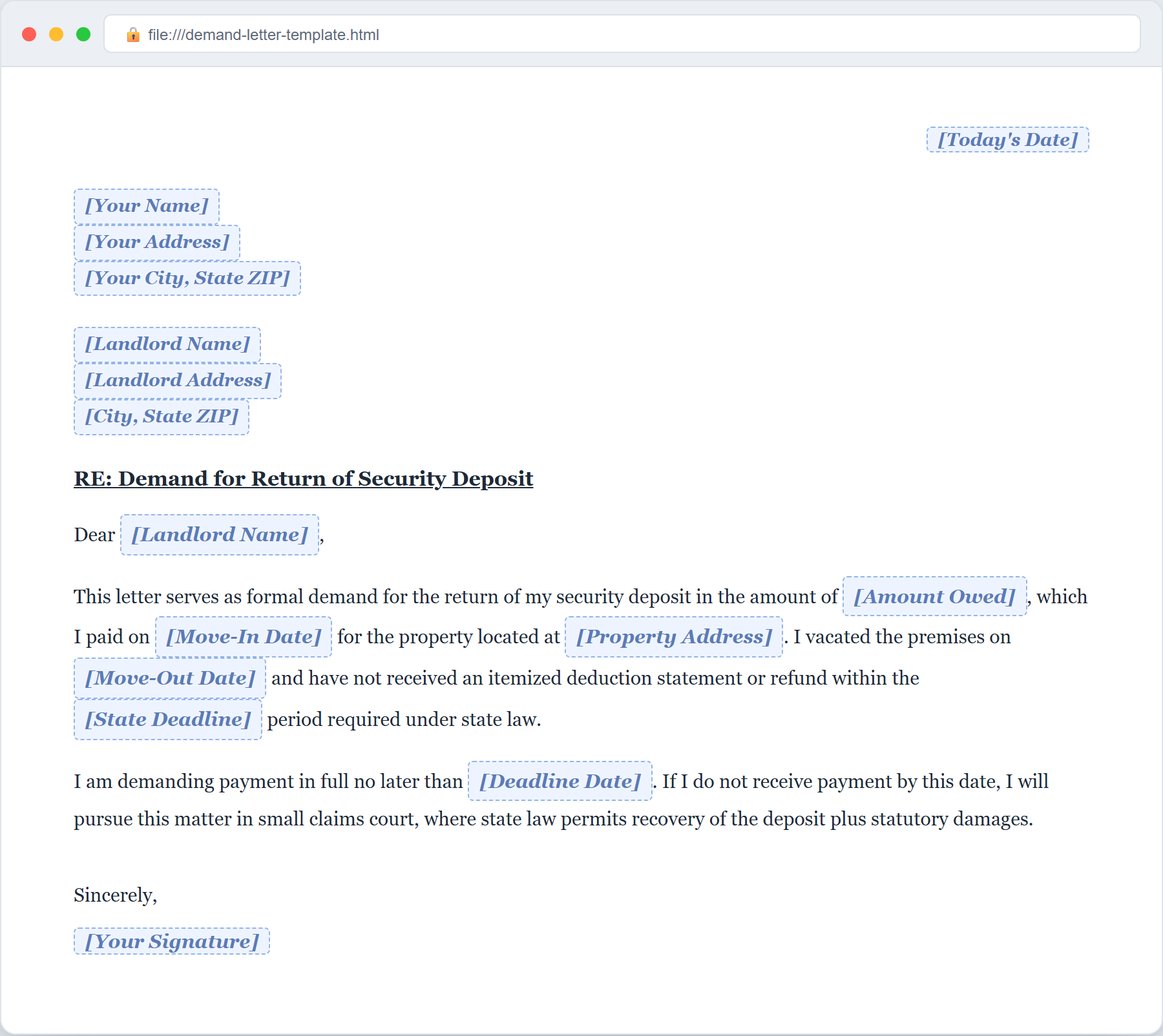 See exactly what you get
- 6 variants included: General, Landlord/Tenant, Contractor, Unpaid Loan, Property Damage, Follow-Up Notice
- Fillable HTML — open in any browser, click fields to type, print to PDF when done
- Editable Word (.docx) — fill in Microsoft Word using Find & Replace
- Certified mail instructions included — how to send, what to keep as proof
- Instant download — ready to fill in and send today
HTML, Word (.docx)
Secure checkout via Payhip · Instant delivery · 30-day guarantee