You Won in Small Claims Court. Now How Do You Actually Get Paid?
The judge ruled in your favor. The other person nodded and walked out. Three weeks later — nothing. Here's what the court didn't tell you about step two.
"Won small claims 2 months ago. Judge awarded me $1,200. The defendant hasn't paid and is completely ignoring me. What do I actually do next? I thought winning was the hard part."
One of r/legaladvice's most-commented small claims threads — asked in some variation hundreds of times a year. The frustration is universal: nobody tells you that a judgment and a check are two very different things.
View discussions on RedditNot legal advice. This article is for informational purposes only. Cost figures are drawn from official state court fee schedules. Legal rules cited below link to official state legislature and court websites (.gov). Consult a licensed attorney in your state for advice on your specific situation.
Here's what the court didn't explain when the judge said "judgment for the plaintiff": the court's job ends the moment they sign that order. Getting the money from the other person's pocket into yours is entirely your problem.
This surprises nearly everyone. You won. They lost. Shouldn't they just… pay? Sometimes they do. But when they don't, the court will not call them, will not send a collections agent, and will not follow up. You need to enforce the judgment yourself — and there's a specific legal process for doing it.
The good news: the process exists, it works, and in most cases the enforcement costs get added to what they owe you.
What a Judgment Actually Is (And What It Isn't)
A money judgment is a court order declaring that one person owes another a specific amount. It is not a payment. It is legal permission to go collect — using court-backed enforcement tools that a regular person cannot access without it.
Think of it as a key. The judgment is the key. The money is still locked inside the other person's paycheck, bank account, or property. Your job now is to use the key.
Get a certified copy of your judgment from the court clerk. You'll need it to file any enforcement action. Cost is usually $5–$25. Without it, you can't proceed.
The 3 Ways to Collect — and When to Use Each
There are three main enforcement tools available after winning a judgment. Which one to use depends on what you know about the defendant's situation.
| Method | How It Works | Best When | Avg. Timeline |
|---|---|---|---|
| Wage Garnishment | Court orders their employer to withhold a % of each paycheck | You know where they work | 2–6 weeks to first payment |
| Bank Account Levy | Sheriff seizes funds directly from their bank account | You know their bank | 1–3 weeks if funds exist |
| Property Lien | Judgment recorded against real estate they own — paid when property sells or refinances | They own real property | Months to years (passive) |
$1,200 judgment. Defendant earns $800/week. Federal law caps garnishment at 25% of disposable income — so roughly $200/week. Full collection in 6 weeks. Writ of Execution filing fee: $40. That $40 is added to the judgment balance.
What to Do in the First 30 Days After Winning
Find Your State's Exact Collection Process
Enforcement procedures vary by state — filing fees, sheriff fees, and which assets are exempt differ significantly. Select your state for step-by-step instructions:
Or browse all states on our Judgment Collection guide hub.
Get Paid — Step-by-Step Collection Instructions for Your State
Our judgment collection guides cover wage garnishment, bank levies, and property liens — with the exact forms, fees, and deadlines for all 50 states.
What If They Have Nothing to Take?
Some defendants are "judgment-proof" — meaning they have no wages to garnish, no bank account with funds, and no property to lien. This is frustrating but not permanent.
- Keep the judgment alive. Most states let you renew a judgment before it expires. An active judgment on record affects their credit, appears in public record searches, and can be enforced the moment their situation changes.
- Certain income is exempt from garnishment. Social Security, disability payments, and unemployment benefits are federally protected from garnishment under SSA guidelines. If that's their only income, garnishment won't work right now.
- Situations change. People get jobs, receive inheritances, buy cars, open bank accounts. A judgment you hold today can be enforced years from now.
Most states require you to actively renew a judgment before its expiration date to keep it enforceable. Missing the renewal window means starting over. Set a calendar reminder for 6 months before the expiration date in your state.
How Long Do You Have to Collect?
Judgment enforcement periods are set by state statute. Most states give you 5–10 years from the date of judgment, with renewal options.
California: 10 years, renewable — CCP § 683.020 (leginfo.legislature.ca.gov)
Texas: 10 years — CPRC § 34.001 (statutes.capitol.texas.gov)
Florida: 20 years — F.S. § 55.081 (flsenate.gov)
New York: 20 years — CPLR § 211 (nysenate.gov)
Can't afford enforcement fees? You may qualify for a fee waiver.
Most states waive Writ of Execution filing fees for low-income filers. See if you qualify.
A professionally written demand letter template that puts the other party on notice before you file. Courts expect a demand letter before you sue — and it gets you paid 40% of the time without ever stepping foot in a courtroom. Works in all 50 states.
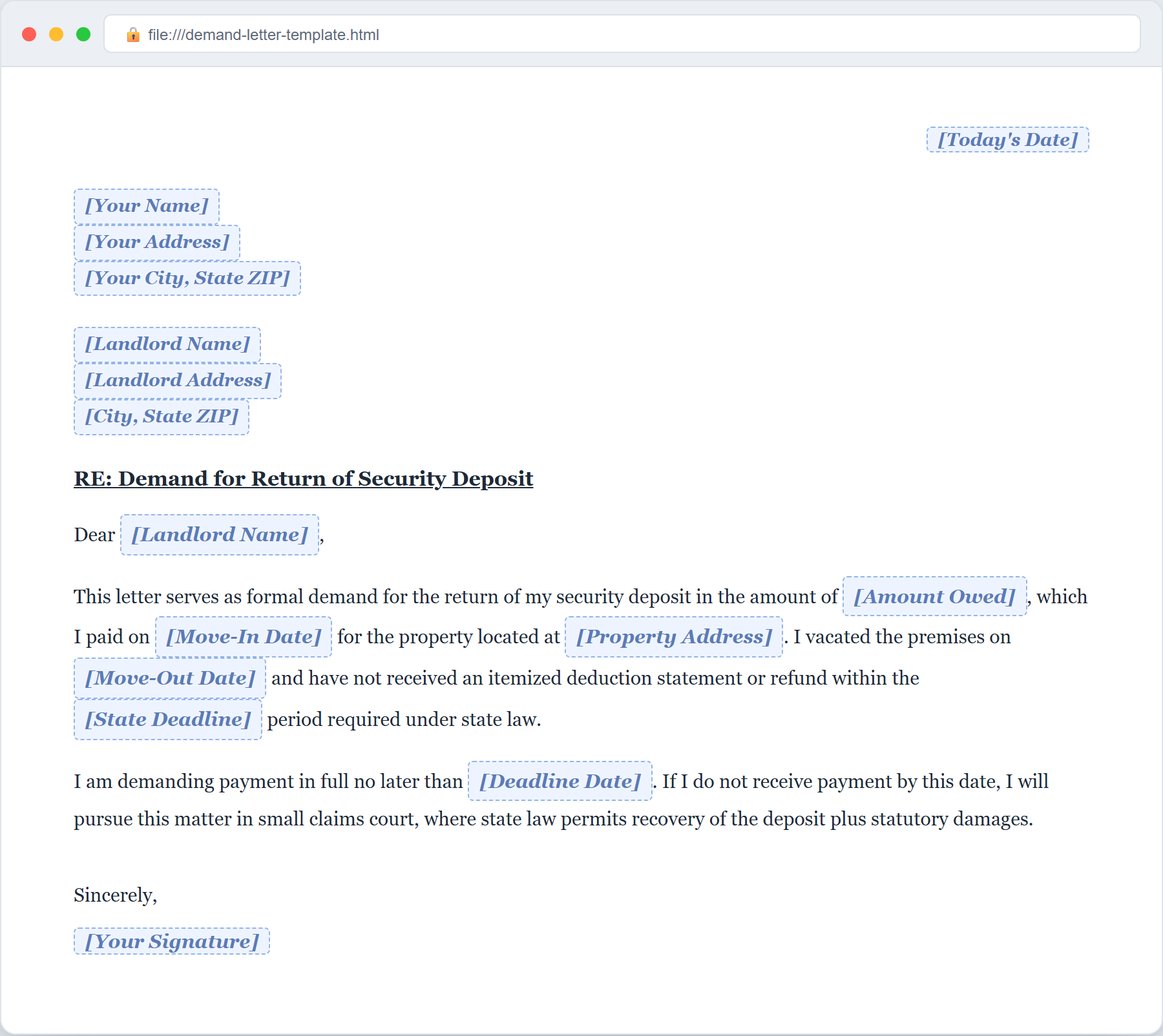 See exactly what you get
- 6 variants included: General, Landlord/Tenant, Contractor, Unpaid Loan, Property Damage, Follow-Up Notice
- Fillable HTML — open in any browser, click fields to type, print to PDF when done
- Editable Word (.docx) — fill in Microsoft Word using Find & Replace
- Certified mail instructions included — how to send, what to keep as proof
- Instant download — ready to fill in and send today
HTML, Word (.docx)
Secure checkout via Payhip · Instant delivery · 30-day guarantee
Frequently Asked Questions
How long do I have to collect a small claims judgment?
What if the person who owes me has no job or bank account?
Can I garnish wages after winning small claims court?
How do I find the defendant's bank account or employer?
What does it cost to enforce a judgment?
Sources & References
- California CCP § 683.020 (leginfo.legislature.ca.gov) — 10-year judgment enforcement period
- Texas CPRC § 34.001 (statutes.capitol.texas.gov) — 10-year judgment enforcement period
- Florida Statute § 55.081 (flsenate.gov) — 20-year judgment lien period
- New York CPLR § 211 (nysenate.gov) — 20-year enforcement period
- U.S. Department of Labor — Wage Garnishment Fact Sheet (dol.gov) — federal limits on wage garnishment under the Consumer Credit Protection Act
- CFPB — What Is a Wage Garnishment? (consumerfinance.gov) — consumer protections and exemptions
- California Courts — Small Claims Self-Help (courts.ca.gov) — enforcement procedures and forms
- USA.gov — Small Claims Court — federal overview including post-judgment steps