How to Find a Notary in California (2026)
Where to get documents notarized in California — fees, what to bring, and remote online notarization options.
Notary Fees & RON Guide — All 50 States
 See exactly what you get →
A state-by-state reference covering notary fee caps, remote online notarization (RON) availability, and step-by-step instructions for getting documents notarized from home. Know your rights and the legal maximums before you pay a notary.
- All 50 states — fee caps for acknowledgments, jurats, oaths, and RON
- RON availability map — which states allow remote online notarization in 2026
- Step-by-step guide to getting documents notarized via video call
- Mobile notary tips — what to ask upfront, how to avoid overcharging
- Instant download — open in any browser, print to PDF
Code SUMMER20 = 20% off at checkout
Secure checkout via Payhip · Instant delivery · 30-day guarantee
Step-by-Step: Getting Documents Notarized in California
Identify your notarial act type
Different documents require different notarial acts. An acknowledgment is the most common — you acknowledge you signed willingly. A jurat requires you to swear under oath that the document's contents are true. An oath or affirmation is used for affidavits. Understanding the type helps you prepare and ensures you bring the right document.
Find a notary near you
California notaries can be found at many convenient locations:
• Banks and credit unions — often free for account holders
• UPS Store / FedEx Office — $10–$15 per signature, walk-in friendly
• Public libraries — sometimes free or low-cost
• Law offices — available for clients, often free with other services
• AAA offices — free for members
• Online notary search — use the California Secretary of State's notary lookup at the link below
Prepare your document
Before your appointment: complete all parts of the document except your signature. Do not sign the document beforehand — you must sign in front of the notary. Make sure all text fields are filled in. If the document is multi-page, do not staple or bind it yet.
Bring valid photo ID
The notary must verify your identity. Bring a current, government-issued photo ID such as:
• Driver's license or state ID card
• U.S. passport or passport card
• Military ID
• Permanent Resident Card (Green Card)
The name on your ID must match the name on the document. Expired IDs are generally not accepted.
Sign in front of the notary
Sign your document in the notary's presence. The notary will watch you sign, verify your willingness, and then apply their official seal and signature. For a jurat, you'll also swear or affirm that the document's contents are true.
Know the fees
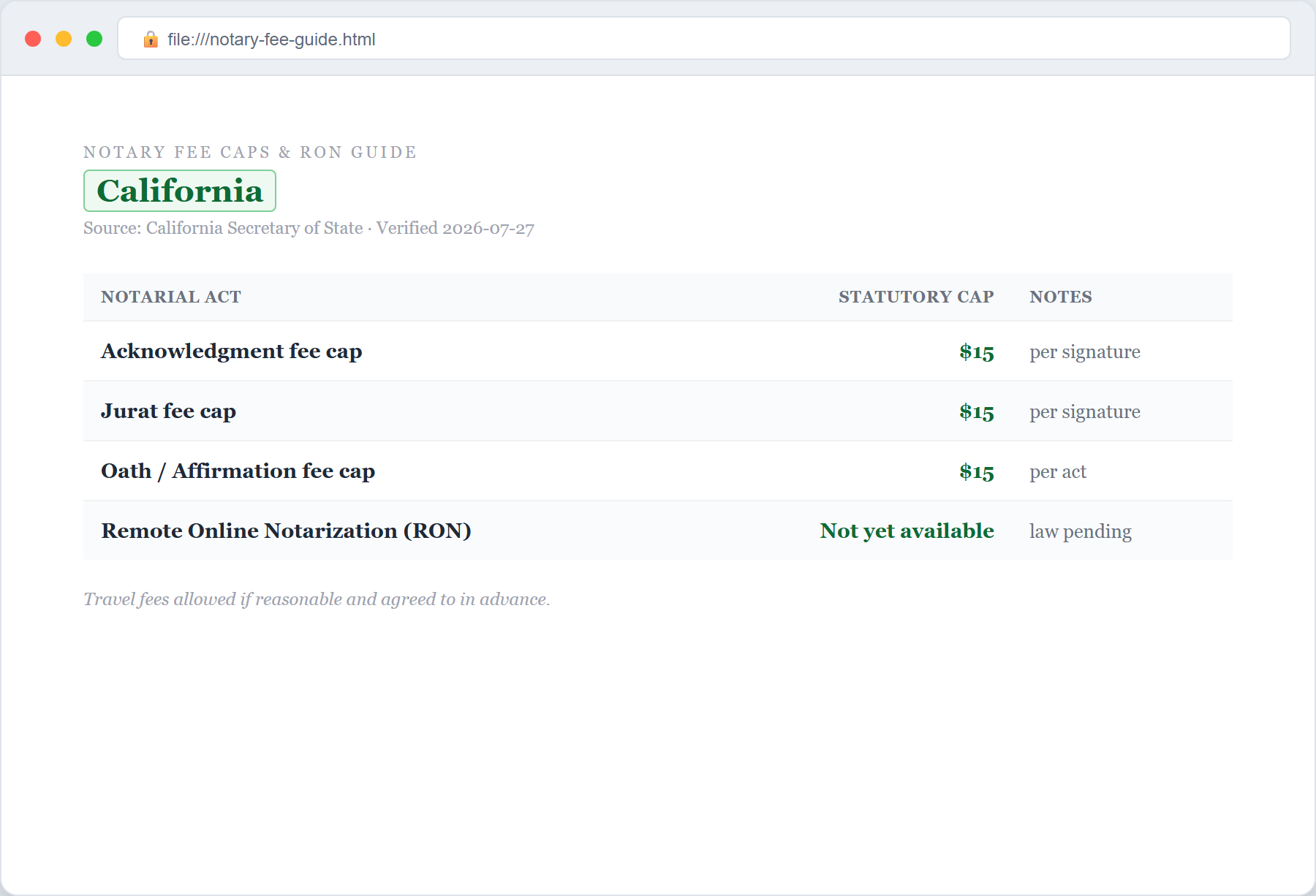
California law caps notary fees at $15 per notarial act. Notaries may charge additional travel fees if they come to you.
$15 per notarized signature. Travel fees allowed if reasonable and agreed to in advance. RON law pending.
Consider Remote Online Notarization (RON)
California does not currently permit Remote Online Notarization (RON), or RON rules are not yet fully defined. You will need to appear in person before a notary. Check the California Secretary of State's website for any recent updates.
After notarization
Keep the notarized document in a safe place. Make photocopies for your records before submitting the original anywhere. If you need an apostille (to use the document internationally), contact the California Secretary of State's office — there's usually a separate apostille fee.
Need Online Notarization?
Get documents notarized from home via video call — available 24/7, legally valid in most states.
Mobile notaries charge $40–$75 with travel fees. Online: about $25, done in 15 minutes.
California Notary — Fee Summary
| Acknowledgment fee cap | $15 |
| Jurat fee cap | $15 |
| Oath/Affirmation fee cap | $15 |
| RON (Remote Online Notarization) | Not available |
| State fee cap law | Yes |
California note
$15 per notarized signature. Travel fees allowed if reasonable and agreed to in advance. RON law pending.Source: California Secretary of State ↗