What Is a Prenuptial Agreement?
A prenuptial agreement — or "prenup" — is a legal contract two people sign before marriage that spells out how property, debts, and assets will be divided if the marriage ends in divorce or death. It's one of the most flexible legal tools in family law.
Not legal advice. Prenuptial agreement law varies by state. Consult a licensed family law attorney for advice specific to your situation.
How a Prenuptial Agreement Works
A prenuptial agreement is a private contract between two people who intend to marry. It goes into effect on the day of the wedding — not before. The agreement defines each person's rights and obligations regarding property and finances in two scenarios: divorce and death.
The core legal concept behind a prenup is the distinction between separate property (what each person owned before marriage) and marital property (what you acquire together during the marriage). Without a prenup, state law determines how marital property is divided in divorce. A prenup lets you override those defaults and write your own rules.
For a prenup to be enforceable, virtually every state requires:
- Written form — oral prenups are not enforceable
- Voluntary signing — both parties must sign freely, without duress or coercion
- Full financial disclosure — both parties must disclose their assets and liabilities
- Independent legal counsel — ideally each person has their own attorney; some states require this or create a rebuttable presumption of unfairness without it
- Reasonable advance notice — courts look unfavorably on prenups signed days before the wedding; negotiate well in advance
What a Prenup Can and Cannot Cover
- Division of pre-marital assets in divorce
- Protection of business ownership interests
- Inheritance rights and estate planning
- Student loan and other pre-marital debt responsibility
- Spousal support (alimony) terms or waivers
- How property acquired during marriage is classified
- Protection of family wealth / inheritance from parents
- Financial obligations during the marriage
- Child custody or child support (courts override this)
- Non-financial personal matters ("who does chores")
- Anything encouraging divorce
- Anything that violates state public policy
- Waiving child support rights
- Anything signed under duress or fraud
Who Should Consider a Prenuptial Agreement
Prenups were once associated with wealthy people protecting large fortunes, but they've become a mainstream planning tool for a much broader group. A prenup is worth considering if either of you:
How Much Does a Prenuptial Agreement Cost?
Prenup cost varies widely depending on how you get it done and how complex your financial situation is:
| Method | Cost range | Best for |
|---|---|---|
| Two separate attorneys (recommended) | $1,500–$10,000+ | Complex assets, business ownership, high net worth |
| One attorney drafts, other reviews | $800–$3,000 | Moderate assets, simpler situations |
| Online platform (HelloPrenup) | $599–$899/couple | Straightforward finances, lower net worth |
| DIY template (not recommended) | $0–$99 | Not recommended — enforceability risk |
Full breakdown of costs by state and approach: How Much Does a Prenup Cost?
Prenuptial Agreement vs. Postnuptial Agreement
A prenuptial agreement is signed before marriage. A postnuptial agreement (or "postnup") is signed after you're already married. Both accomplish the same goals — defining property rights and financial obligations. Postnups are sometimes used when couples didn't get a prenup before the wedding but realize they should have, or when their financial situation has significantly changed during the marriage (e.g., one spouse starts a business).
Courts in some states scrutinize postnups more carefully than prenups, since they're signed within an already-existing marital relationship where one party might have more leverage. Independent legal counsel is especially important for a postnup.
Get a Legally Valid Prenup Online — Starting at $599
HelloPrenup guides both partners through a collaborative process to create a legally binding prenuptial agreement. Attorney-reviewed, enforceable in all 50 states. Significantly cheaper than two separate attorneys.
Prenup attorneys charge $2,500+ per couple. HelloPrenup is one flat fee.
A complete guide to filing an uncontested divorce without an attorney. Includes a step-by-step state-specific checklist, asset/debt inventory worksheet, and marital settlement agreement outline — everything you need before you walk into the courthouse.
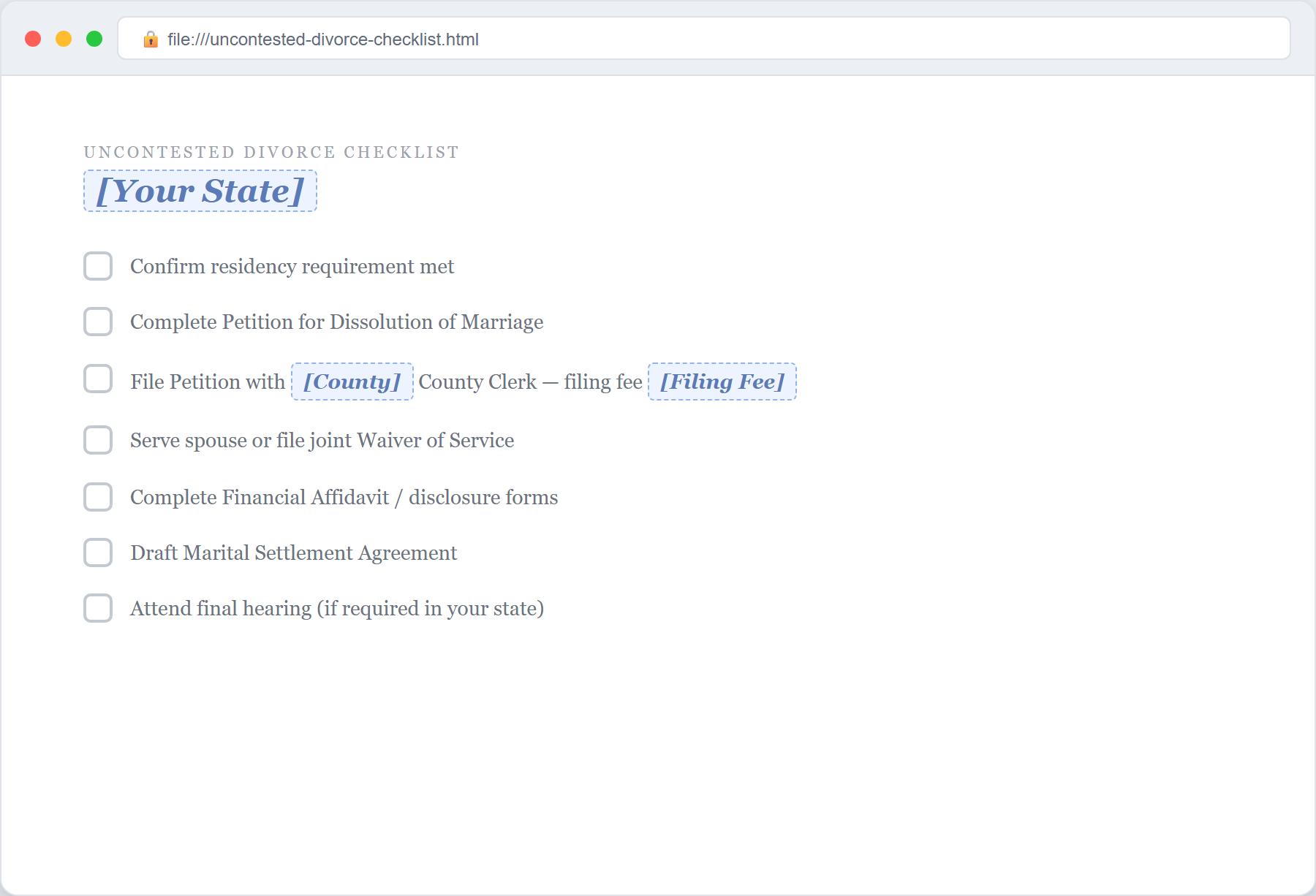 See exactly what you get
- State-specific filing checklist for all 50 states
- Asset & debt inventory worksheet — prevents disputes later
- Marital settlement agreement outline
- Service of process guide — how to legally serve your spouse
- Fillable HTML + editable Word (.docx) — fill in browser or Microsoft Word
HTML, Word (.docx)
Secure checkout via Payhip · Instant delivery · 30-day guarantee